7 Acupressure Points for Back Pain Relief
Back pain affects roughly 80% of adults at some point in their lives. While medication and physical therapy are common treatments, acupressure offers a natural, drug-free approach you can practice at home. By applying firm pressure to specific points on the body, you can help relieve tension, improve circulation, and reduce pain.
These 7 acupressure points are the ones most commonly used for back pain in Traditional Chinese Medicine. They're also the points recommended in the Massage Map 3D app, where community ratings reflect how effective users found each one.
The 7 Points
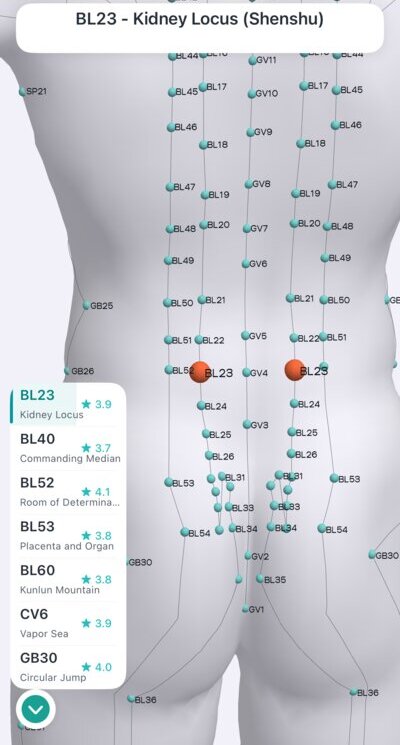
Location: On the back, find the spinous process of the 2nd lumbar vertebra, then move 2 finger widths away from the spine (1.5 cun lateral to the lower border of the spinous process of the 2nd lumbar vertebra).
Why it works: BL23 is one of the most important points for lower back pain in TCM. It tonifies the kidneys, which are closely linked to back and bone health in Chinese medicine. Also effective for chronic fatigue, knee weakness, and urinary issues.
Technique: Use your thumbs to apply firm, steady pressure for 1-2 minutes. You can also use a tennis ball against a wall to reach this point yourself.
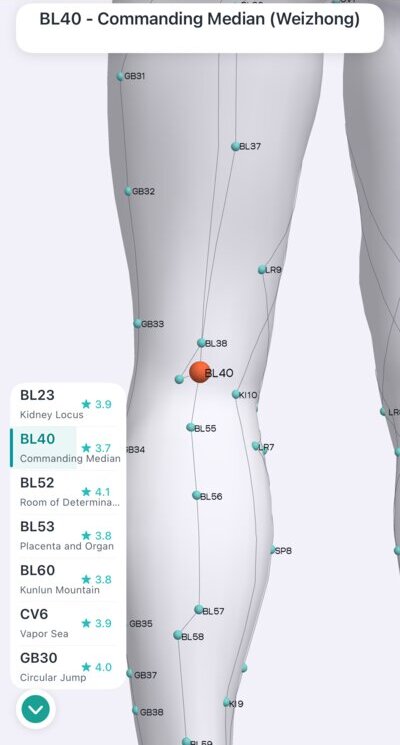
Location: At the midpoint of the crease behind the knee (the popliteal crease).
Why it works: Known as the "commanding point of the back" in TCM, BL40 is the go-to distal point for any back condition. It lies on the Bladder meridian, which runs along the entire spine. Practitioners often treat this point first for acute back pain.
Technique: With the leg slightly bent, press firmly into the center of the knee crease with your thumb. Hold for 30 seconds to 1 minute, then release. Repeat 3-5 times.
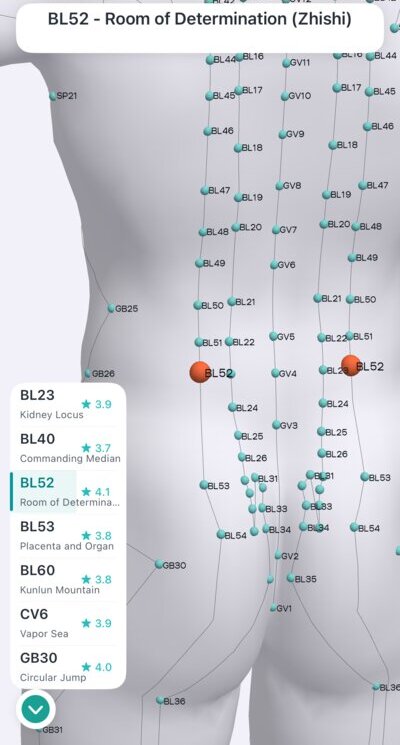
Location: On the lower back, 3 cun (about 4 finger widths) lateral to the lower border of the spinous process of the 2nd lumbar vertebra. It sits just outside of BL23.
Why it works: BL52 is the highest-rated point for back pain among Massage Map 3D users. It works alongside BL23 to address lower back pain, but targets the deeper paraspinal muscles. Particularly helpful for chronic, dull lower back ache and stiffness.
Technique: Use your thumbs or knuckles to press into the muscles on either side of the lower spine. Apply steady pressure for 1-2 minutes. Combine with BL23 for best results.
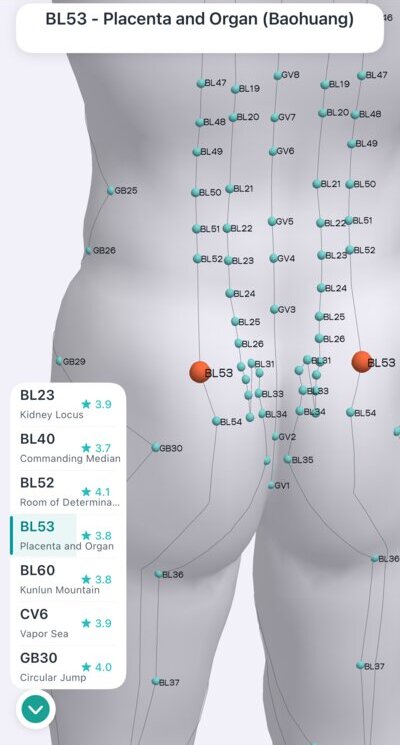
Location: On the sacrum, 3 cun lateral to the midline, at the level of the 2nd sacral foramen.
Why it works: BL53 targets the sacral area — the lowest part of the back where many people experience pain. It helps with lower back pain that radiates into the buttocks and is effective for sacroiliac joint discomfort.
Technique: Lie on a firm surface with a tennis ball or massage ball under the point. Let your body weight provide the pressure. Hold for 1-2 minutes per side.
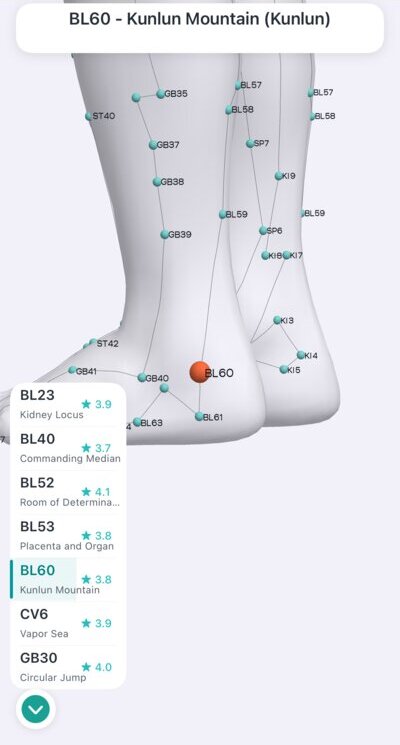
Location: In the depression between the outer ankle bone (lateral malleolus) and the Achilles tendon.
Why it works: Despite being at the ankle, BL60 is highly effective for back pain because it lies on the Bladder meridian — the same channel that runs along the spine. It's especially useful for acute lower back pain with stiffness and difficulty bending.
Technique: Pinch the point between your thumb and index finger. Apply firm pressure for 30 seconds to 1 minute per side.
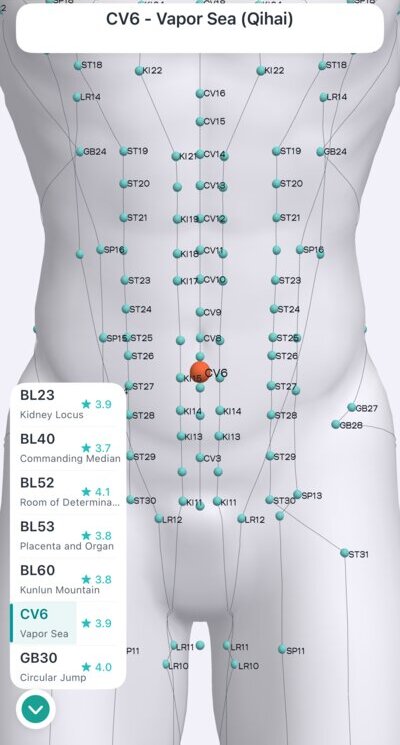
Location: On the midline of the lower abdomen, 1.5 cun (about 2 finger widths) below the navel.
Why it works: CV6 is a major qi-tonifying point. In TCM, back pain is often associated with qi deficiency — and strengthening the body's core energy helps the back heal. Particularly useful when back pain is accompanied by general fatigue or weakness.
Technique: Lie on your back. Place two or three fingers just below the navel and press gently inward. Hold with steady, moderate pressure for 2-3 minutes while breathing deeply.
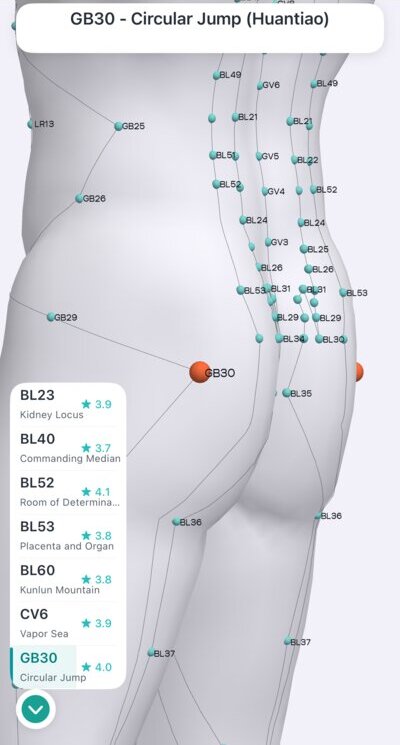
Location: On the buttock, one-third of the way from the greater trochanter (the bony prominence at the side of the hip) to the base of the coccyx (tailbone).
Why it works: GB30 is the primary point for sciatica and back pain that radiates into the hip and leg. It's located directly over the sciatic nerve pathway and is one of the highest-rated points in the app for back pain relief.
Technique: Lie on your side and use your elbow or a tennis ball to apply deep pressure. Hold for 1-2 minutes. This point can be quite tender — start gently and increase pressure gradually.
Tips for Effective Self-Acupressure
- Apply steady pressure — use your thumb, knuckle, or a tennis ball. The pressure should feel firm but not sharp or painful.
- Hold for 1-2 minutes per point. Breathe deeply and relax into the pressure.
- Work both sides — most points are bilateral (on both sides of the body). Apply pressure to both left and right.
- Be consistent — acupressure works best with regular practice. Try a 10-minute session daily.
- Combine points — using 3-4 points together is more effective than a single point. Start with BL23 + BL40 + BL52 for a strong combination.
- Check community ratings — in the app, ratings show which points other users found most effective. BL52 (★4.1) and GB30 (★4.0) are the highest-rated for back pain.
Explore All 7 Points in 3D
Massage Map 3D lets you find these points on an interactive 3D body model. Tap any point to see its exact location, indications, and techniques. Browse by "Back" under Ailments to see all 7 points.

When to See a Doctor
Acupressure can be a helpful complement to other treatments, but see a healthcare professional if your back pain:
- Lasts longer than 4-6 weeks without improvement
- Radiates down one or both legs with numbness or tingling
- Follows a fall, injury, or accident
- Is accompanied by fever, unexplained weight loss, or bladder/bowel changes
← Back to Kehaar Labs · Headache guide · Acupressure vs acupuncture